



Delaware Statutory Trusts (DST)
&
1031 Exchanges

The passive, tax-deferred path forward for real estate investors.
Your Delaware Statutory Trust & 1031 Exchange Headquarters
Asset Strategy helps real estate investors and income property owners leverage the benefits of DSTs and 1031 Exchanges, providing guidance on exchange possibilities and pre-screened replacement properties.
Our team has spent more than 35 years building tax-saving strategies for property owners who want to stay invested in real estate without the burden of active management.
We coordinate the full transaction with qualified intermediaries, sponsors, and your CPA, so the moving parts move on time.
Institutional Real Estate, Made Accessible
A DST allows investors to purchase a fractional interest in high-quality properties or portfolios across asset classes typically reserved for institutional capital. Some examples include:
What Investors Stand to Gain
Potential Benefits
When structured properly, a DST 1031 can deliver tax deferral, income, and diversification without the demands of active landlord ownership.
1)
Passive Ownership
2)
Tax Deferral
3)
Income Potential
4)
Appreciation
5)
Diversification
Two Strategies, Working Together
- A 1031 Exchange is the tax tool.
- A Delaware Statutory Trust is one of the most flexible replacement property structures available within it.
1) The 1031 Exchange
- Sell an investment property and reinvest the proceeds into another, deferring federal capital gains tax.
- The replacement property must be of equal or greater value to fully defer the gain.
- You have 45 days to identify a replacement and 180 days total to close, with both clocks starting at the sale of the original property.
- A qualified intermediary must hold the proceeds throughout the exchange.
- The strategy has existed in some form since 1921.
2) The Delaware Statutory Trust
- A trust formed under Delaware law that holds title to institutional-quality real estate on behalf of multiple investors.
- Each investor owns a beneficial interest in the trust, which the IRS treats as eligible like-kind replacement property for a 1031.
- A professional sponsor manages every operational responsibility, including leasing, financing, and maintenance.
- Investors receive a pro-rata share of any rental income the property produces.
- DSTs are illiquid, long-term, accredited-investor-only Reg D offerings.

A Simple Way to Understand
Delaware Statutory Trust (DST)
- A DST lets a group of investors share ownership of a big property together
- Think of it like chipping in with friends to buy a pizza too expensive for one person
- Your share might be part of an apartment building, warehouse, or medical office
- A professional sponsor handles all the work, like repairs and renters
- You can receive a share of any rental income the property earns (distributions are not guaranteed)
1031 Exchange
- A 1031 Exchange lets you sell an investment property and buy a new one while delaying the capital gains taxes
- Think of it like trading in your old bike for a new one, the taxes get pushed off, not erased
- The new property must be worth the same or more to fully delay the tax
- You have 45 days to pick the new property and 180 days total to close (both clocks start the same day)
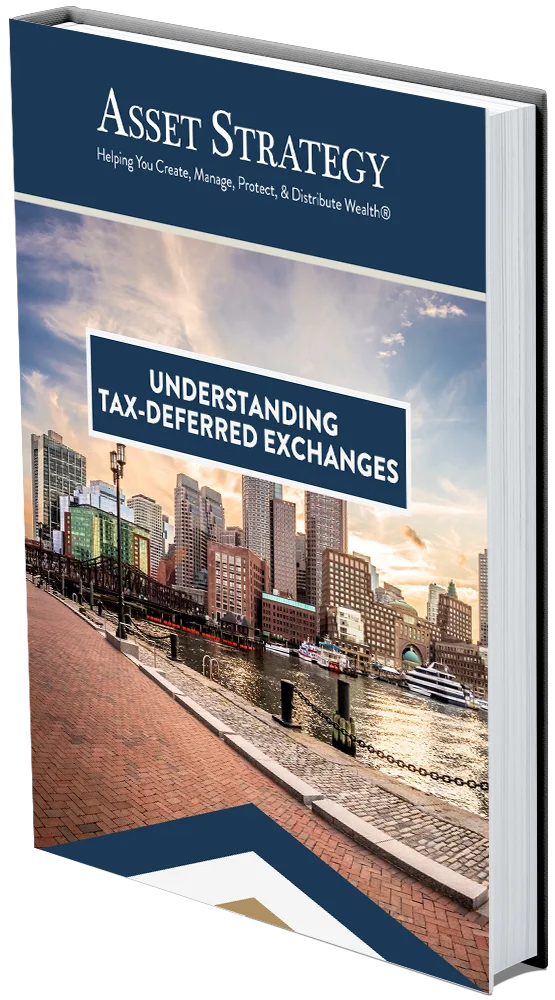
Get Our Guide ‘Understanding Tax-Deferred Exchanges – 2026’
Are You Ready to Begin?
Schedule a 15-Minute Discovery Call, and feel free to download our guide. We discuss your property, your timeline, and whether a 1031 Exchange or a DST may be a fit.
DST 1031 Frequently Asked Questions
What is a Delaware Statutory Trust?
A Delaware Statutory Trust (DST) is a legal entity formed under Delaware trust law that may be structured to qualify as eligible “like-kind” replacement property for the purposes of 1031 Exchanges.
DSTs permit eligible investors to become proportional owners of professionally managed, institutional-quality real estate projects alongside other accredited investors. As such, DSTs permit Exchangers the potential of achieving the tax benefits of 1031s when exchanged into a passively owned, turnkey investment property.

What is a 1031 Exchange?
A 1031 Like-Kind Exchange allows an investor or business owner to sell an investment property and replace it with another property (passive or active ownership) of equal or greater value within a time frame of 180 days from the date of close using a qualified intermediary. If all the criteria are met the investor can defer taxes on up to 100% of capital gains created from the sale of the original property. Some form of 1031 Like-Kind exchanges has been around since 1921.
What are the benefits?
Passive Investing
- DSTs can help relinquish the burden of managing properties without giving up the benefits of real estate investing. DSTs have professional management, so investors don’t have to deal with tenants and associated upkeep.
Tax Benefits
- As a 1031 exchange, landlords can sell their investment properties, defer all income tax on the sale of the properties and avoid leaving a tax burden to their heirs. If structured properly, in addition to tax deferral treatment, this investment product can provide long-term income and asset preservation.
Income Generation
- With DSTs, you can collect monthly income on-time with no worries about maintenance, repairs, or vacancies with a portion of this income being received potentially tax-free. DSTs also allow you the ability to participate in increasing income based on any applicable rent increases.
Value Appreciation
- You will be able to capture your share of any appreciation of the DST investment properties over time.
Diversification
- DSTs offer you the opportunity to diversify your portfolio by giving you the ability to choose investments with various geographic locations, property types and debt leverage.

What are the steps toward completing an Exchange?
The path toward successful 1031 exchanges includes incorporating and understanding several key steps:
- Consult early on with 1031-familiar real estate professionals to help with your sale and finding replacement property/properties.
- Engage an experienced Qualified Intermediary (we can make a referral) to handle the transaction.
- Confirm the Qualified Intermediary can securely protect your exchange proceeds during the period between your exchange sale and replacement property purchase.
- Align with professionals specializing in the DST marketplace who have ready access to a selection of pre-screened DSTs vetted by a thorough due-diligence process.
- Expect strong coordination and frequent updates from your 1031 exchange team.
- Start searching for Replacement Property as early as your schedule allows to avoid rushes and deadline crunches
TIMELINE FOR 1031 EXCHANGE

What are the different ownership types of replacement properties that qualify in a 1031 like-kind exchange?
There are a few different paths an exchanger can go down. They first need to decide if they want to be a passive owner or an active owner. If they want to be an active owner, they can look for property locally or nationally and buy that property and continue being an active landlord. If you are looking to become a more passive owner of RE while still completing a 1031 Like-Kind Exchange there are two fractional ownership structures that the IRS has approved. Tennant-in-Common (TICs) and Delaware Statutory Trusts (DSTs) are two passive, fractional ownership structures that the IRS has approved for 1031 exchanges. Please call 855-676-1031 to hear more.
How does a Delaware Statutory Trust (DST) work?
A Delaware Statutory Trust (DST) is a type of ownership structure that is under Delaware law. When a DST is properly structured, it will be deemed a grantor trust for federal income tax purposes and the purchaser of the fractional ownership interest in the trust will acquire an undivided share of the asset(s) held by the DST. If all the rules are followed, DSTs are approved to use in a 1031 Like-Kind Exchange.
Are the benefits of investing in a DST in a 1031 Like-Kind exchange similar to buying active physical real estate?
A DST may offer potential benefits that maybe similar to owning physical property when conducting a 1031 Like-Kind Exchange. As always, it’s always best to reach out to our firm to explain your personal situation to see if a DST is right for you.
Some of the potential benefits are potential for monthly income, step up in basis at death, diversification of properties (property types and geography), institutional quality property, and hands-off management to name a few.
As in any investment there are risks and the need to be an Accredited Investor (SEC Accredited Investor Definition) so please reach out to 855-676-1031 or our firm to learn more and see if a DST could be a fit.
Are there potential risks associated with DSTs?
Yes, as in any investment there are risks associated with it. First off, you need to be an Accredited Investor (SEC Accredited Investor Definition) because of the complex structure of DSTs. These are usually Reg D, illiquid, long term investments. Like any investment there is possibility of the investment losing money, income stream to stop or decrease, etc. As always, reach out to 855-676-1031 or our firm to see if a DST is the right fit for you. Investors should review all risks before making an investment.
Do DST replacement properties have a minimum investment typically?
Yes, investment minimums vary for each offering, but typically they are $100,000 for 1031 investors and $25,000 for cash non-1031 investors. Minimum investment amounts are clearly disclosed on our Marketplace and the respective Offering Materials. Investment minimums are set by the offering sponsor. Please contact 855-676-1031 or our firm if you have specific questions on minimum investment amounts.
Is there a maximum investment amount per property replacement interest offering?
Maximum investments vary depending on the size of the investment and are the discretion of the offering sponsor.
For investors with more than $1 million to invest, our firm offers customized 1031 options. Please contact us at 855-676-1031 to discuss your needs.
DST 1031 properties are only available to accredited investors (typically defined as having a $1 million net worth excluding primary residence or $200,000 income individually/$300,000 jointly of the last three years; or have an active Series 7, Series 82, or Series 65. Individuals holding a Series 66 do not fall under this definition) and accredited entities only. If you are unsure if you are an accredited investor and/or an accredited entity, please verify with your CPA and Attorney.
IRC Section 1031, IRC Section 1033 and IRC Section 721 are complex tax concepts, therefore you should consult your legal or tax professional regarding the specifics of your particular situation.
There are risks associated with investing in real estate and Delaware Statutory Trust (DST) properties including, but not limited to, loss of entire investment principal, declining market values, tenant vacancies, lack of liquidity with restrictions on ownership and transfer. Potential cash flow, returns and appreciation are not guaranteed and could be substantially lower than anticipated. Diversification does not guarantee profits or protection against losses.
There are material risks associated with investing in real estate securities including illiquidity, general market conditions, interest rate risks, financing risks, potential adverse tax consequences, general economic risks, development risks, and potential loss of the entire investment principal.
Because investor situations and objectives vary this information is not intended to indicate suitability for any individual investor.
Asset Strategy does not offer legal or tax advice. Please consult the appropriate professional regarding your individual circumstances.
There is no guarantee investment plans will meet its objectives.
This site is published for residents of the United States only. Representatives may only conduct business with residents of the states and jurisdictions in which they are properly registered. Therefore, a response to a request for information may be delayed until appropriate registration is obtained or exemption from registration is determined. Not all of services referenced on this site are available in every state and through every advisor listed. For additional information, please contact Asset Strategy at info@assetstrategy.com
